Friday, January 26, 2007

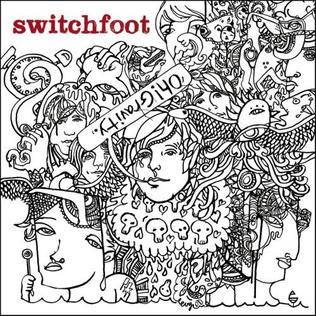
Switchfoot - Oh! Gravity.

I was at my friend Andy’s house, and I just happened to notice that he had Switchfoot’s new album, Oh! Gravity. just as I was leaving. He said, “You wanna borrow it? It’s really bad.” I thought sure, Andy. Switchfoot couldn’t possibly be bad. All their other albums were at least passable, so they couldn’t possibly make a switch that was so dramatic. So what’s the worst that could happen? How wrong I was…

My first thought after listening to it for the first time was that it would be awesome if we had a time machine, so we could go back to before this record came out and either convince the members of Switchfoot that putting this record out was a bad idea, or kill them. Kinda savage, I know, but if that’s the price we have to pay to have this horror NOT unleashed on the world, then so be it. That was just a visceral reaction, and obviously my hatred of this album has lessened some. It is not, however, enough to keep me from anti-recommending this abortion with extreme prejudice.

From the very first second of the record, Switchfoot takes a wrong step. The song “Oh! Gravity.” sounds like a throwback to the worst part of the 80s, the part with wild hairstyles and spandex pants. The title is horrible for the song, let alone naming the album after it. After that comes “American Dream,” one of the only listenable tracks on the album. I kind of appreciate the disillusionment he expresses on this and “Circles,” but it’s getting a little old, as that was the central idea behind Nothing is Sound. “Dirty Second Hands” has a discombobulating and inconsistent groove to it, and while it does kind of intrigue me, it’s just too sloppy to be worth it. “Awakening” harkens back to the days of Learning to Breathe and The Beautiful Letdown, and the respite is welcome. And “Head Over Heels” has a mournful aspect to it that is kind of nice, even if Jon Foreman shouts where he should whisper.

I haven’t touched on the incredible ineptitude and presumption that the album displays, however. My first example is “Amateur Lovers.” First off, this song is an attempt at a carbon copy of the Nothing is Sound track “Easier Than Love,” which is a horrible enterprise at the very start. “Easier Than Love” smartly took an abstract and personified it, and that leaves “Amateur Lovers” with nowhere to go. Jon Foreman must have been trying to make up for the lack of ideas by upping the intensity of the song, but he sounds like an over-excited tuberculosis patient when he does that. I don’t understand the shift towards gruff intensity that Switchfoot has taken in their last few albums, since they do subtle beauty so much better. This song is horrible, and I’m surprised that Switchfoot thought we were stupid enough to fall for it.

My second example is “Faust, Midas, and Myself.” This song has problems up the Yangtze, from tune (unmemorable) to rhythm (grating) to lyrics (shut up, just shut up) to variety of sound (it has none). The lyrics represent Foreman’s tendency towards very cerebral and philosophical songwriting gone awry. The song has an absolutely wretched title (that makes two), and the music is wrong-headed and infantile. My third example is “4:12.” When I saw the title of this on the back sleeve, I thought it was a reference to a Bible verse, and some warning bells went off in my head. Switchfoot’s Christianity has always been very subtle, and that’s one of the few areas where they haven’t taken a misstep. I was wrong in my original guess, and it’s not about a Bible verse; the sin of this song is much, much worse. 4:12” is a reference to the time on a digital clock, as in four hours and twelve minutes. That in and of itself is fine, but the track clocks in at exactly four minutes and twelve seconds. Switchfoot is basically saying, “Aren’t we clever? We are; we’re so clever. We deserve a pat on the back; several, actually. I’m sure our audience thinks we’re really clever, too. I’m sure they don’t hate us for thinking they’re of sub-standard intelligence.” Not buying it, guys.

I better wrap up this review before I get too angry. When the anger fades, however, there will only remain disappointment that Switchfoot has hit their first low. It’s one of inept musicality, and worse, derision towards the audience.

Prime Cuts:
American Dream

22 Rating: -15

Friday, January 12, 2007

Muse - Black Holes & Revelations

For a couple years, I had heard whispers about Muse, that they were the new Radiohead and such. Now that I’ve gotten the chance to actually listen to their music, I can say that it’s completely not true. To suggest that Muse is just Radiohead-lite cheapens Radiohead and Muse both. It cheapens Radiohead because nobody sounds like them. They’re one of the only entities in music that’s totally unique. It cheapens Muse because they aren’t just a cheap knock-off of another band, though they owe debts to Duran Duran and Depeche Mode. Matthew Bellamy sounds eerily like Thom Yorke in his Pablo Honey/The Bends days, but that’s really where the similarities end. They’re lyrics make way too much sense to bear any comparison, and their music is pretty poppy and catchy. Radiohead is neither, “Creep” excepted. If you’re looking for a Radiohead clone, don’t look here. In fact, don’t look anywhere, because it’s a waste of time.

Muse’s fourth album, Black Holes & Revelations, finds them just as weird, but a little more tuneful, daring, and optimistic. Techno blurs with rock and roll to create a sound that is very reminiscent of 80’s synth pop and goth rock. It’s clear that Muse’s goth beginnings have not completely left them, but they also take elements of Queen and the like for a rather splendid combination.

The strongest thing I can say about Black Holes & Revelations is that it gets a little more interesting on each listen. Bellamy’s fascination with the planet Mars is not overbearing, and the album cover is just cryptic enough that it makes you stare at it intently instead of turn away in disgust. I must say, though, that I’ve never heard as much vitriol and bile spewed at George W. Bush or Republicans in general as Muse does here, not even by Rage Against the Machine. It could be they’re pissed off at Tony Blair, too. Naturally, one can understand their frustration at the leader of a superpower that’s mucking everything up, but from listening to the words of “Take a Bow" and "Exo-Politics,” you would think that Bush murdered Bellamy’s puppy and then had sex with his mother. “You will burn in hell for your sins” doesn’t leave a whole lot of room for forgiveness. “Starlight” provides the most pop moment on the album, and is also the closest thing Muse has done to a happy song. The song is a perfect lead-off single, as it has a relentless beat and a great melody. “Supermassive Black Hole,” clunky title aside, is similarly relentless, and has a groove to it that swims with sweet nastiness. Bellamy sings in a sexy falsetto, and the outer space imagery provides an interesting point of view to the slightly bawdy lyrical content. “Map of the Problematique,” the album’s best song, is lifted almost directly from the Depeche Mode playbook, bordering on plagiarism. But I guess if Weird Al can do it, there’s really no problem with it.

“Soldier’s Poem” has echoes of Queen in it (a band I hate), “Invincible” is a bit too rosy and manufactured for me, and “Hoodoo” can’t make up its mind about what kind of song it is. However, “Knights of Cydonia” more than makes up for all of those. It’s a driving, intense and rocking song that closes the album in a perfectly splendid way. But to really appreciate the awesomeness of this song, you need to see its video. It’s a combination sci-fi adventure/spaghetti western, and has all the requisite elements that would make George Lucas and Sergio Leone proud.

Muse has made a very intriguing album here. They’re not always good, but they at least hold your interest throughout the whole thing. They may be British and ironic, but they refuse to be your new Radiohead.

Prime Cuts:
Map of the Problematique
Knights of Cydonia
Starlight
Supermassive Black Hole

22 rating: 12

Thursday, December 21, 2006

Sarah McLachlan - Wintersong

For me, tied up unceasingly in the traditions of Christmas is the music that goes along with it. Our bodies are hard-wired to create music, and it is an essential part of who we are. The same is true of Christmas. Whatever particular tradition you celebrate, be it the birth of Christ, winter solstice, Chanukah, or even Kwanzaa, I think there’s something inborn in each of us that makes us transform a little around December. Christmas makes us happy, content, generous, and even makes some of us burst into song.

Sarah McLachlan’s Wintersong is the latest contribution to the Christmas music canon. Sarah is one of my favorite female singers, because she is able to create such a specific atmosphere with the power of her voice. She is incredibly talented, and no one else sounds quite like her. She brings a unique quality to everything she does, and Christmas music is no exception. On Wintersong, she covers the spread from hymns to pop classics to lost pop gems to original material. With this album, I am struck by Sarah’s ability to inject soft melancholy to something like Christmas, and to make me feel not sad about it, but contemplative. Her voice is haunting in places and soothing in others, and that is brought home especially when she performs this sort of material. Each artist can bring their own perspective to Christmas music, and therein lies part of the beauty of it.

Sarah’s rendition of “Happy Xmas (War is Over)” catches me as being particularly beautiful. The style and cadence of her voice lend itself to this song to bring out the effect of it twice as well as when John Lennon did it. Sarah McLachlan is on another level of entertainers, one of performers who use their fame for philanthropic efforts to help the less fortunate. On “Happy Xmas (War is Over),” she records with the Sarah McLachlan Musical Outreach Choir & Percussion Ensamble, and the kids add a whimsical element to the already wistful music. “Have Yourself a Merry Little Christmas” and “In the Bleak Midwinter” are very nice and uplifting tunes. “River,” which was originally recorded by Joni Mitchell, has sadness and yearning in its gentleness, and Sarah’s one original tune here, “Wintersong,” is the most melancholy moment on the album. But like I said before, the lowness of the music doesn’t depress you; instead, it makes you quietly reflect on the true meaning of Christmas, and you realize that very little is necessary to truly enjoy it. Sarah pulls off a very neat trick here, making music that makes you feel sad, but a good kind of sad, a sad that makes you feel happiness all the more.

The most interesting moment on the album is “The First Noel/Mary Mary.” She very oddly chooses a minor key for this uplifting carol, and then adds deep drums and echoing voices to give the song an Arabian feel. It seems weird, but she doesn’t oversell it, and instead delivers a gently subtle performance, like everything else she does. It’s quite a feat, but Sarah makes you believe it 100%.

Sarah McLachlan has made a very pretty album with Wintersong, and its beauty is soft and subtle rather than vast and engaging. She doesn’t try very hard, but I don’t think she has to. I probably wouldn’t like this album nearly as much if it weren’t composed of Christmas music, and my estimation of it will probably go down a bit in the beginning of January. But for now, with Christmas almost upon us, I gladly add it to the canon of Christmas music.

Prime Cuts:
Happy Xmas (War is Over)
Have Yourself a Merry Little Christmas
The First Noel/Mary Mary
Wintersong

22 Rating: 10

On behalf of all of us at Drop 22 (which is just me), I want to wish you and yours a very merry Christmas! May the joy of Jesus’ birth fill your heart!

Thursday, December 14, 2006

Weird Al Yankovic - Straight Outta Lynwood

Parody bands are the best, bar none, at what they do. They have to play such a wide array of styles, and they have an energy not found in other mediums of music. Only wedding bands can rival them for proficiency, tightness, and endurance. And as far as parody bands go, Weird Al Yankovic commands the best one.

Weird Al has a pretty good gig. The ebb and flow of trends in the music world is crazy and unpredictable, and every standard artist runs the risk of becoming not relevant at the drop of a hat. Weird Al, on the other hand, rides on the coattails of the current trend, whatever that may happen to be. He will always be popular because the entire point of his music is to do a version of what is already popular. It’s really kind of ingenious.

His latest album, Straight Outta Lynwood, is his tightest, most cutting, most relevant album to date. Like only Weird Al can, he sweetly skewers the MP3 craze, hip-hoperas, American nationalism/superiority, and ridiculous litigation. Since the mid-nineties, he has been kind of hit or miss, and he’s fallen into an alternating good album/bad album pattern since Off the Deep End. Running With Scissors was pretty smart and witty, but Bad Hair Day and Poodle Hat were a little on the kitschy and esoteric side. Though as the years go by and he has tried more and more things, he constantly comes up with new ways to attack the parody animal. Even so, he remains the same on a few things, like his polka medleys. Straight Outta Lynwood contains his 9th one, and the trend has not lost even a tiny bit of its irony or hilarity. “Polkarama!,” the latest entry into his polka catalog, successfully skewers/pays tribute to Weezer, the Killers, Snoop Dogg, Franz Ferdinand, Kanye West, the Black Eyed Peas and more. The opening track, “White & Nerdy,” is the best, though. It pokes fun at a section of society that revels in its ridiculousness, and wears it like a badge of honor: geeks. Parodies of nerds and nerd life are always well-received and embraced by nerds. All the things Weird Al mentions are elements of geek-world that geeks enjoy about themselves. As a player of Dungeons & Dragons, I must admit I got a charge out of the “Got skills, I’m a champion at D&D” line. I gladly admit that I’m a geek, and “White & Nerdy” celebrates the stuff I love about that distinction.

The rest of the album is nothing to sneeze at, either. “Canadian Idiot” is more than just the logical extension of Green Day’s “American Idiot.” It’s a commentary on a relevant social issue as well as being entertaining, like a good comic book. I’m amazed at Weird Al’s band’s ability to adapt itself to any style under the sun with such precision and accuracy, as “Close But No Cigar” (style parody of Cake) and “I’ll Sue Ya” (style parody of Rage Against the Machine) demonstrate. “Weasel Stomping Day” is an example of Weird Al’s twisted sense of humor, and “Don’t Download This Song” is a deliciously ironic statement about internet “pirates,” as well as artist “rights.” Then there’s “Trapped In the Drive-Thru,” a note-perfect parody of R-Kelly’s uber-epic “Trapped In the Closet.” The actual “Closet” clocks in at 42 minutes, and goes from a standard tale of infidelity to completely ridiculous situations over the span of its twelve parts, and doesn’t have even a shred of a sliver of a point. “Drive-Thru” is similarly pointless, or maybe the point of it is that it is pointless. It’s funny, but too long for me to actually listen to.

Hopefully, Weird Al is actually immortal, so he can go on making fun of music trends as long as there are trends to be made fun of. He is a vitally important presence is the music world, as he teaches us to not take ourselves completely seriously. Many artists have learned this lesson, and see a parody of one of their songs or their style by Weird Al as a high honor. As for those who haven’t, they just illustrate the point that Weird Al has been making all along.

Prime Cuts:
White & Nerdy
Close But No Cigar
I’ll Sue Ya
Polkarama!

22 Rating: 11

Thursday, December 07, 2006

OK Go - Oh No

OK Go start playing, and I can’t help but be waiting for the catch. It seems too simple, too basic, too good to be true. Here we have a rock band that plays rock, and there’s nothing else. One part of me says “At last, a band with no agenda or plan!” But another part says, “That’s it?”

And indeed, that’s it. I’ll admit that rock and roll has become pretty cumbersome lately, with the likes of Coheed & Cambria and Green Day making high-concept metal and rock, almost qualifying as art. Then you have bands like the Killers, making rock that takes itself very seriously. That’s all well and good, but you need a little fun to balance all that out. OK Go provide the no-strings-attached jubilation necessary to create a break from the ponderous (but still good) rock music that has become all too common these days; the problem is that it passes away so quickly. It’s nice while it lasts, but that’s not very long.

OK Go bears a striking resemblance to the Cars, and their second album, Oh No, has a lot in common with that band’s pop niceties. Oh No is a very pop album, from the high-octave backing vocals to the pastel shirts of the band. The biggest example, however, is in the band’s video for the big single off this album, “Here It Goes Again.” At the base of it, this video is not much; just a stationary camera with no special effects or CGI. It involves the members of OK Go doing an elaborate dance on eight running treadmills, arranged in a 4x2 square, with alternating directions. It’s a little hard to explain, but unless you’ve been living under a rock for the past four months, you’ve already seen this video. It got released on YouTube the day before it premiered, with an insane number of people viewing it the very first day. The dance created such a buzz that many people don’t know that it’s actually the band doing the dance, or even that it’s a music video at all. The dance itself is pretty amazing, and it reminds me of the Mentos and coke thing that some people did, synchronizing the coke explosions to music. If that’s not a pop phenomenon, I don’t know what is.

Oh No begins on a pretty tight and intense note with “Invincible,” a light-hearted superhero story with a dirty groove. Most of the rest of the album sticks pretty closely to that formula, with the deviations (“Let It Rain,” “Maybe This Time”) being kind of haphazard. OK Go is a pretty simple-minded band, and for the most part, they stick to what they have expertise in. It’s when they don’t that things start to fall apart. They don’t exhibit much in the way of originality, either. The guitars and vocals only have two tones (loud and quiet), and the two aren’t really all that different from each other. Like any album of such a specific color, it starts to unravel toward the end. “A Good Idea at the Time” and “The House Wins” are fun and bouncy anthems, but other tracks, like “Television, Television” and “Do What You Want” have a lot of intensity but not much grace, tunefulness, or even pop appeal.

This is only OK Go’s second album, but they should have learned a few tricks of the trade by now. They can’t be expected to be fall-down awesome like the Smashing Pumpkins and the Decemberists were at this juncture in their career, but they are expected to at least progress a little. All in all, Oh No isn’t groundbreaking or world-changing, but it does make you snap your fingers and nod your head a little. There just wasn’t anything to make it very memorable.

Prime Cuts:
Here It Goes Again
Invincible
The House Wins

22 Rating: 3

Friday, December 01, 2006

Death Cab for Cutie - Plans

Transatlanticism left me begging for Ben Gibbard to let his inner rock star out. 2 years from the release of that album, he seems to have taken my advice and done the opposite. Gibbard and crew have made one of the prettiest, most touching, and emotionally affecting albums in a long time… so why do I feel like I’ve been cheated out of something?

Basically, Plans is the work of a man who is really not all that ambitious. I can understand that, since I’m not all that ambitious either. But every single track on Plans makes me think that Death Cab for Cutie could have done so much more. I realize that Death Cab got a lot of media attention super-quickly because of Transatlanticism, and all that pressure can cause some people to withdraw. I think that’s what happened with Plans. There was so much hype surrounding it that Death Cab purposefully made it underwhelming, as if to say “We’ll make whatever album we want to make, and we won’t be swayed by the likes of you.” You gotta respect that.

Chris Walla is a masterful producer, I must say. His style is very understated, subtracting elements rather than adding them, and that suits Death Cab for Cutie very well. Sometimes he goes as far as to have just Ben and an acoustic guitar, as on “I Will Follow You Into the Dark.” Plans is a very quiet album, and Death Cab doesn’t grasp for anything throughout the entire proceedings. The problem is not that it doesn’t shoot for the moon, but that it doesn’t even shoot for the tops of the trees. It’s pretty, but it doesn’t challenge or captivate us the way some of their previous albums did.

The bouncy fun of “I Was a Kaleidoscope” and “Death of an Interior Decorator” is only present on one song (“Crooked Teeth”), as the dark intensity of “We Looked Like Giants” only shows up on “Someday You Will Be Loved.” “Crooked Teeth,” while the big single, doesn’t have the mark of lyrical excellence that we’ve come to expect from Gibbard. It’s a little like those two songs were only included as hold-overs so Ben could get back to the ponderous beauty of the rest of the album. There is beauty, but it’s a schmaltzy beauty, and even a cheap beauty in places. I’d rather Death Cab didn’t try for beauty at all if it’s going to be cheap. The exception is “What Sarah Said,” which is marvelous. Here, all the elements come together in exactly the right way to create a song that is filled to the brim with pain, sadness, and unbelievable beauty. It represents a moment where the protagonist’s understanding shifts to a higher level, one that can only be reached when you have a brush with death, be it your own or that of someone you love.

Speaking of death, there seems to be a lot of it on Plans. However, that’s a point of credit to the album, because it’s evident that Gibbard has an understanding of death that not a lot of other artists have. I myself have been very close to death, so that resonates with me in a very special way. Gibbard has said in interviews that Death Cab for Cutie’s other albums have been about looking back in sadness, but that Plans was much more optimistic. After all, to make plans, you have to have something to look forward to. It is optimistic, but it’s odd that an album that is so optimistic would be so concerned with death. The album is nice, but it feels incomplete, and I feel like I only got half the story. With the exception of “What Sarah Said,” the whole thing feels kind of like a joke you don’t really get, but laugh at anyway. Your joke has a good build-up, Ben. I just hope that with the next album, you give us the punch-line.

Prime Cuts:
What Sarah Said
Soul Meets Body
I Will Follow You Into the Dark
Brother On a Hotel Bed

22 Rating: 9

(Just for the record, Transatlanticism has increased in my estimation from a 10 to a 13.)

Thursday, November 30, 2006

Same great product, brand new packaging!!!

Just to let you all know, I will be posting under my main identity, which is Particle Man. Don't be alarmed when the reviews don't come from Gamgee anymore; it's still the same person.